
Alex Peters · 14 October 2026
Bridging Handwritten Journal Practices With Modern Digital Note Tools for Hybrid Users
Hybrid note-taking combines the tactile feedback of pen on paper with the searchability and portability of digital platforms, and researchers continue to document how users move between these formats without losing the strengths of either. Data from multiple studies shows that people who maintain both handwritten journals and digital repositories often achieve higher retention rates during learning tasks, while they also gain faster access to archived information through keyword search functions.
Current Patterns Among Hybrid Users
Surveys conducted through 2025 and into October 2026 indicate that roughly 42 percent of knowledge workers in professional settings alternate between paper notebooks and tablet-based applications on any given workday. Those who follow this pattern typically begin entries by hand during meetings or brainstorming sessions, then photograph or scan the pages for upload into tools such as OneNote or Notability. The process preserves the spatial layout and personal annotations that handwriting provides, while the digital copy receives tags, links, and optical character recognition that turns script into editable text.
Observers note several consistent workflows across industries. In academic environments, students frequently draft outlines on paper before transferring key points into shared digital documents for group projects. In healthcare, clinicians record patient observations in bound journals during rounds and later import the data into electronic health record systems to meet compliance standards. Each transition step relies on reliable scanning hardware or built-in camera features that maintain legibility even when pages contain diagrams or marginal notes.
Technical Integration Methods
Applications designed for hybrid use now include features that reduce friction during the transfer stage. Stylus pressure sensitivity on tablets replicates the line variation of fountain pens, and some platforms allow users to import PDF templates that mimic the grid or dot patterns common in traditional journals. Once pages are digitized, machine learning models trained on diverse handwriting samples convert script to searchable text with reported accuracy rates above 95 percent for English-language notes, according to benchmarks published by academic computing groups.
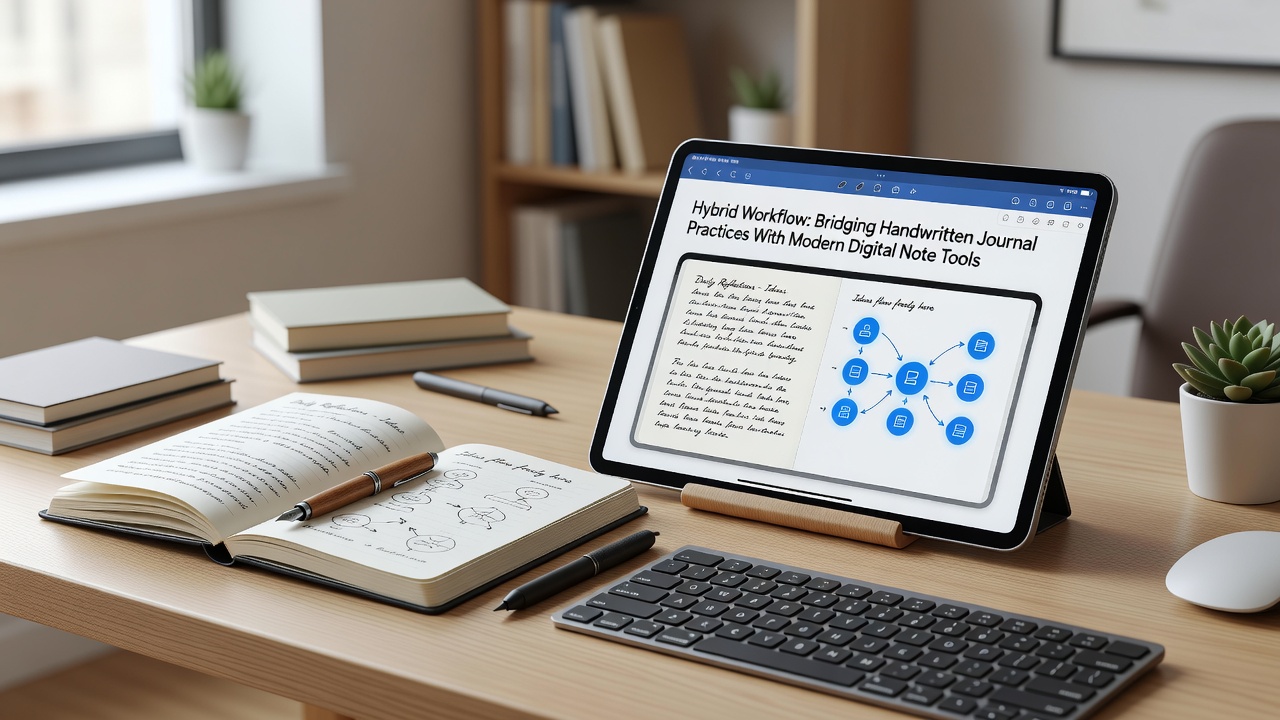
Cloud synchronization services keep both formats aligned across devices. When a user adds a new handwritten page at home, the scan appears on a work computer within seconds, complete with any color-coded highlights or sticky-note attachments. Version histories stored on these platforms let individuals revert to earlier drafts if a digital edit overwrites an important detail that existed only in the original paper entry.
Evidence on Cognitive and Practical Outcomes
Controlled experiments conducted at universities across North America and Europe have compared recall performance between groups that take notes exclusively by hand, exclusively on keyboards, and in hybrid configurations. Results published in peer-reviewed journals show that hybrid participants score comparably to pure handwriting groups on conceptual questions, while they outperform both single-mode groups when asked to locate specific facts days later. The combination appears to leverage the motor memory benefits of writing while adding the indexing advantages of digital search.
Additional data collected by national statistical agencies, including reports from Statistics Canada on workplace technology adoption, reveal that hybrid users report lower rates of information overload compared with colleagues who rely solely on digital input. The physical act of writing appears to slow the capture process enough to encourage summarization, after which the digital layer handles volume and retrieval.
Organizational and Regulatory Considerations
Enterprises that encourage hybrid practices must address data governance policies that cover both physical and electronic records. Retention schedules originally written for paper files now extend to scanned images and their metadata, and security teams apply encryption standards to the digital versions while maintaining chain-of-custody procedures for any physical journals that contain sensitive content. Guidance issued by the OECD on digital record management emphasizes the need for consistent metadata schemas so that handwritten material remains discoverable during audits or legal discovery processes.
Training programs within large organizations often include modules on choosing appropriate paper types for later scanning, as glossy or heavily textured pages can reduce OCR accuracy. Users also learn to date and label physical entries in ways that match the folder structures used in their digital repositories, creating a single reference system that functions across both media.
Conclusion
Hybrid note-taking continues to evolve as device capabilities and recognition algorithms improve, yet the core practice remains anchored in the complementary strengths of handwriting and digital search. Organizations and individuals who establish clear transfer protocols and consistent metadata practices gain measurable advantages in both retention and retrieval. Ongoing research through 2026 and beyond will likely refine the technical bridges that make these transitions seamless while preserving the cognitive benefits long associated with putting pen to paper.